Owning music vs streaming it: what you get from each
Streaming licenses access for as long as you keep paying. Owning means holding a copy that plays regardless. What each is genuinely better at, and a ten-year cost model you can check.
Streaming licenses you access to a catalogue for as long as you keep paying and the underlying deals hold. Owning music means holding a copy of a recording on storage you control, which keeps playing whether or not any company is still in business. Those are different products that happen to deliver the same songs, and most of the arguments about them are two people comparing different things.
Be precise about what “owning” means here, because the loose version of the claim is wrong. Buying a download does not make you the owner of the recording — copyright stays with the rights holders. It makes you the owner of a lawful copy. What that buys is control: over where the file lives, what software reads it, whether it is backed up, and whether it still plays in 2040.
Streaming is genuinely better at several things, and this article says which.
Access, purchase, and a copy are three different things
Almost every comparison of this subject has two columns. There are really three rungs, and the middle one is the one people get wrong.
Three rungs, not two
-
Rung one · Subscription
Access, revocable
Ends when payment or the licence ends
A monthly permission to play from a catalogue the service licenses from rights holders. Spotify's terms describe it as "limited, non-exclusive, revocable permission", and state that Spotify "has no obligation to provide any specific content". Offline downloads are an encrypted cache inside the app, not files.
-
Rung two · Store purchase
A licence, plus a receipt
Permanent in intent, not guaranteed in the terms
Apple's Media Services terms say that "by each Transaction you acquire a license to use the Content only", and that content "may be removed from the Services and become unavailable for further download or access from Apple". A purchase history is not storage.
-
Rung three · A copy you hold
A file on your own disk
Independent of every account above it
Downloaded, ripped from a disc you bought, or exported — and then backed up. This is the only rung where continued access depends on your storage rather than on somebody else's systems remaining willing and solvent.
That middle rung explains a lot of confused advice. “Buy instead of streaming” is only durable if the buying ends with a file in your own folder. Left in a store’s cloud, a purchase is a stronger version of the same dependency, with the vendor’s own terms reserving the right to remove it.
What each side is actually better at
Most of the rows below are trade-offs rather than wins. Ticking them all in one column would be dishonest.
| Dimension | Streaming | A collection you own |
|---|---|---|
| Catalogue size | Tens of millions of tracks, immediately | Whatever you have acquired |
| Cost of entry | One month’s subscription | Per album, indefinitely |
| Discovery | Very strong: editorial, algorithmic, social | You have to go and find things |
| Cost at scale | Flat, regardless of how much you listen | Rises with every acquisition |
| Effort | None. No files, no folders, no backups | Real and ongoing |
| Permanence | Ends with the subscription or the licence | Ends when your last copy is lost |
| Availability | Subject to licensing, region and takedowns | Unaffected once you hold the file |
| Specific version | Whatever the service currently carries | Exactly the master you acquired |
| Metadata | The service’s, unchangeable | Yours, editable, portable |
| Offline | Encrypted cache, capped, needs a check-in | The file, anywhere, forever |
| Software choice | The service’s client | Any player that reads the format |
| Account dependency | Total | None |
| Failure mode | Loses everything at once | Loses whatever was not backed up |
Read as a whole, that table says something more interesting than “one of these is better”: streaming optimises for breadth and effortlessness, ownership optimises for control and permanence. If you want to hear a great deal of music, streaming is extraordinarily good at it. If you want to still have a specific record in twenty years, it is the wrong tool, and no amount of adding it to a library changes that.
Two rows deserve expanding, because they are the ones people underestimate in each direction.
What streaming does that a collection cannot
Breadth at a fixed price. A subscription decouples cost from consumption. Listen to four hundred new albums this year and it costs exactly the same as listening to four. There is no acquisition model that competes with that, and pretending otherwise is how ownership advocacy loses credibility.
Discovery that works. Editorial playlists, radio built from a track, and recommendations trained on tens of millions of listeners are genuinely good at surfacing things you would not have found. A folder on a disk recommends nothing. Serious collectors generally solve this by using streaming as the discovery layer and buying what survives repeated listening — which is a strategy, not a contradiction.
No maintenance. No drives, no backups, no tagging, no format decisions. Organising a large local library is real work, and a subscription genuinely spares you all of it.
What a collection does that streaming cannot
It survives a commercial decision. Catalogues change. Licences lapse, albums are pulled, remasters replace originals in place, and a service can stop existing. Spotify’s terms are explicit that it “may remove access to particular songs, videos, podcasts, audiobooks and other Content without notice”. None of that reaches a file already on your disk.
It pins a specific master. If the pressing or remaster you care about is the one you ripped, that is the one you keep hearing. Streaming gives you whichever version the rights holder currently supplies, and a silent substitution is not announced.
Offline actually means offline. Streaming offline is a licensed cache: Spotify caps downloads at “as many as 10,000 tracks on each of up to 5 different devices” and requires you to “go online at least once every 30 days to keep your downloads”. A file needs none of that, and works on a plane, in a basement, or in 2045.
You choose the software. A collection outlives the application that reads it — which is the entire argument behind local-first design. Your files, someone else’s player, replaceable at any time.
What a subscription depends on that a file does not
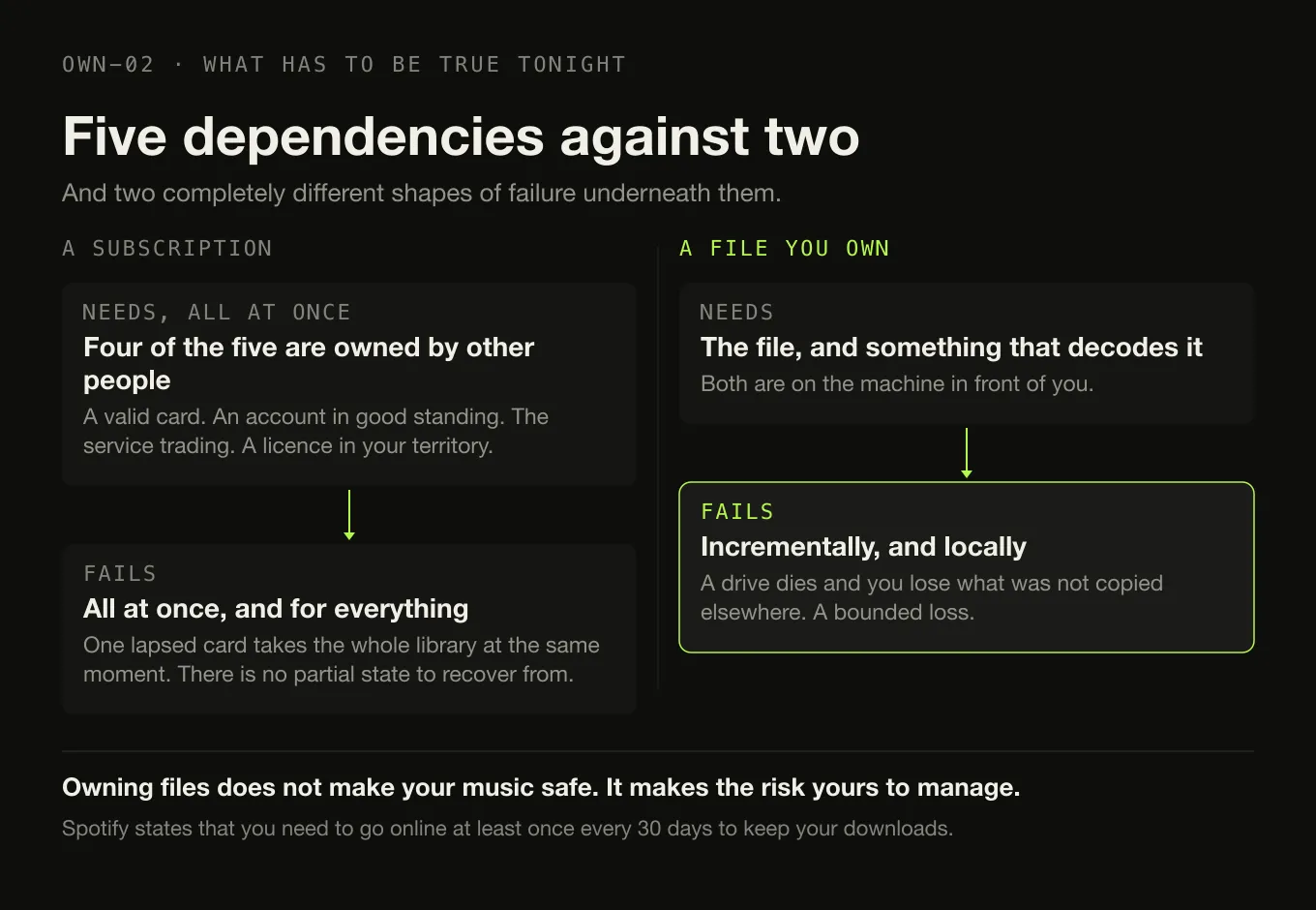
Resilience is the dimension the table above compresses into one row, and it deserves unpacking, because the two failure modes are shaped completely differently.
Playing a track from a subscription requires, simultaneously: a valid payment method, an account in good standing, the service still trading, the service still holding a licence for that recording in your territory, and — for offline listening — a connection at least once every thirty days. Spotify states the last one directly: “You need to go online at least once every 30 days to keep your downloads.” Five dependencies, four of them owned by other people.
Playing a file requires: the file, and something that decodes it.
The important asymmetry is not the count, though, it is the shape of the failure. A subscription fails all at once and for everything: a lapsed card, a closed service or a regional licensing change takes the entire library at the same moment, and there is no partial state to recover from. A collection fails incrementally and locally: a drive dies and you lose whatever was not copied elsewhere, which is a bounded loss and one that a backup routine converts into an inconvenience.
That is also the honest version of the ownership argument, and it is narrower than the version usually made. Owning files does not make your music safe. It makes the risk yours to manage — which is only an improvement if you actually manage it. An unbacked-up collection on a single external drive is less durable than a subscription, and saying otherwise is the mistake that gives this whole position a bad name.
The money, with the model shown
The content behind this section is arithmetic, so here are the inputs. Published UK prices, checked 22 August 2026, monthly, for the two largest services:
| Plan | Spotify Premium | Apple Music |
|---|---|---|
| Individual | £12.99 | £11.99 |
| Student | £5.99 | £5.99 |
| Duo | £17.99 | — |
| Family | £21.99 | £19.99 |
Ten years at a flat price, ignoring introductory offers:
Ten years of subscription, at today's price
-
Individual
£1,438.80 – £1,558.80
£11.99 × 120 = £1,438.80 · £12.99 × 120 = £1,558.80
The comparison most people mean. Apple Music at the lower figure, Spotify at the higher.
-
Family
£2,398.80 – £2,638.80
£19.99 × 120 = £2,398.80 · £21.99 × 120 = £2,638.80
Divided across up to six people, this is the cheapest access per listener anywhere in the comparison.
-
Student
£718.80
£5.99 × 120 = £718.80
Not sustainable for ten years, since eligibility ends — included because quoting only the most expensive plan would rig the comparison.
Now the other side — and this is where most comparisons cheat, by picking an album price that produces the conclusion the writer already had. The crossover is a function, not a fact. Divide the ten-year subscription total by whatever an album actually costs you:
| If an album costs | £1,438.80 buys | £1,558.80 buys | Albums per year at the crossover |
|---|---|---|---|
| £7 | 205 albums | 222 albums | 21 – 22 |
| £9 | 159 albums | 173 albums | 16 – 17 |
| £12 | 119 albums | 129 albums | 12 – 13 |
| £20 | 71 albums | 77 albums | 7 – 8 |
The right-hand column is the only number that matters, and it is the one nobody quotes: at £9 an album, ten years of an individual subscription costs the same as buying about sixteen albums a year. Buy more than that and ownership is the more expensive path. Buy less — which describes most people — and it is substantially cheaper, and you end the decade holding something.
Three honest qualifications:
- The two sides do not deliver the same product. £1,558.80 of downloads is roughly 170 albums. The subscription is tens of millions of tracks. If you genuinely listen widely, the subscription is not merely competitive, it is cheap.
- Ownership has costs the album price hides. Storage and a real backup routine are part of the model, not an afterthought — a collection with no second copy is one drive failure from being a subscription you cancelled by accident.
- No album price is quoted here as a market fact. The table is parametric on purpose. Substitute what you actually pay.
The quality question, kept separate
There is a persistent claim that ownership wins on sound quality. It is not a claim this site will make, because it does not survive contact with the evidence as usually stated.
A lossy stream is mathematically not the original, and whether you can hear that is a separate question with a separate answer. The most useful evidence here comes from a company with every commercial reason to say otherwise: Apple, describing its own lossless tier, states that “the difference between AAC and lossless audio is virtually indistinguishable”. Most of the Apple Music catalogue is encoded in ALAC “in resolutions ranging from 16-bit/44.1 kHz (CD Quality) up to 24-bit/192 kHz”, offered to subscribers as an option they switch on — so the lossless tier largely removes the quality argument from this comparison rather than settling it.
What lossless versus lossy actually covers is the mechanism: what a psychoacoustic encoder discards, why the loss is one-way, and why audibility is a perceptual outcome established by a blinded listening test rather than a property of a number.
What ownership does give you on quality is certainty about what you have. A file’s format, bitrate, sample rate and bit depth are facts you can inspect. A stream is whatever the service decided to send you today. That is a real difference, and it is a smaller one than the audiophile version of this argument implies.
Choosing, without pretending it is a binary
The hybrid position is not a fudge; it is what most people who care about this actually do.
- Subscribe for breadth and discovery. It is the best discovery tool ever built and it costs less than one album a month.
- Buy the records you would be annoyed to lose. The test is not “do I like this” but “would I mind if this became unavailable”. For most collections that is a few dozen albums, not thousands — which puts you comfortably on the cheap side of the crossover table above.
- Download what you buy, immediately. A purchase left in a vendor’s cloud is rung two, and rung two carries the vendor’s reservations. Get the file.
- Back it up before you grow it. Storage and backup is the difference between a collection and a pile of files with an expiry date.
- Keep the collection independent of any one player. Files in folders, tags in the files, and a player you could replace tomorrow.
Digr sits on one side of this comparison — it plays local files and has no catalogue to rent — and what it does today is deliberately limited to reading your own folders. That is a reason to be suspicious of it as a source on this question, which is why the case above is built out of the services’ own terms and prices rather than out of a preference. What Apple’s Music app does to a file you own is documented behaviour rather than suspicion, and worth reading before the collection grows. Building a collection you will still have in twenty years is the practical follow-on, and it assumes you will keep streaming as well.
Three ways this actually goes
You listen widely and rarely return. Two hundred albums a year, most of them once. Subscribe, and do not feel obliged to buy anything. At any album price in the table above you are far past the crossover, and the flat fee is the cheapest product in this comparison by a wide margin.
You listen deeply to a stable core. Forty albums you return to constantly, plus whatever is new. Buy the forty, subscribe for the rest. At £9 an album that is £360 — about twenty-eight months of an individual subscription, spent once — and at the end of it you hold the records that matter and still have the catalogue.
You care about specific versions. Particular masters, pressings, live recordings, or anything with a licensing history. Ownership is not a preference here, it is the only option that works: streaming supplies whichever version the rights holder currently provides, and substitutions are not announced. This is also the case where ripping discs you already own does more than buying downloads.
None of the three is “cancel your subscription”. The version of this argument that tells you to is usually selling something.
One separate bill worth checking while you are counting: the software that plays the collection is priced on its own terms, and several of the best options cost nothing. What the free music players actually give you, and what the paid ones charge for, is a different sum from the one above — that one is about the music, this one is about the application.
Sources
- Spotify Terms of Use — “limited, non-exclusive, revocable permission to make personal, non-commercial use of the Spotify Service and the Content”; content “licensed, not sold or transferred to you”; Spotify “has no obligation to provide any specific content” and “may remove access to particular songs, videos, podcasts, audiobooks and other Content without notice”. Checked 22 August 2026
- Apple Media Services Terms and Conditions (UK) — “By each Transaction you acquire a license to use the Content only”; content “may be removed from the Services and become unavailable for further download or access from Apple”. Checked 22 August 2026
- Spotify Premium plans and prices (UK) — Individual £12.99, Duo £17.99, Family £21.99, Student £5.99 per month. Checked 22 August 2026
- Apple Music plans and prices (UK) — Individual £11.99, Family £19.99, Student £5.99 per month. Checked 22 August 2026
- About lossless audio in Apple Music — Apple Support — “most of the Apple Music catalogue has now also been encoded using ALAC in resolutions ranging from 16-bit/44.1 kHz (CD Quality) up to 24-bit/192 kHz”; and Apple’s own assessment that “the difference between AAC and lossless audio is virtually indistinguishable”. Checked 22 August 2026
- Spotify — Listen offline — “as many as 10,000 tracks on each of up to 5 different devices”, and “You need to go online at least once every 30 days to keep your downloads”. Checked 22 August 2026
Common questions
Do you own the music you add to your Spotify library?
No. Spotify’s terms grant “limited, non-exclusive, revocable permission to make personal, non-commercial use of the Spotify Service and the Content”, and state that the software and content are “licensed, not sold or transferred to you”. Saving an album to your library is a bookmark into a catalogue Spotify licenses from rights holders, not an acquisition. The terms also say Spotify has no obligation to provide any specific content and may remove access to particular songs without notice.
Is buying music cheaper than streaming?
It depends entirely on how much you buy. A subscription is a fixed cost for unlimited access; buying is a variable cost for a permanent copy. At UK prices checked in August 2026, ten years of Spotify Premium Individual at £12.99 a month is £1,558.80. Whether that is more or less than ten years of buying depends on your album price and how many albums a year you actually acquire — which is why the honest comparison is a crossover point rather than a winner.
Does owning music files mean you own the copyright?
No, and the distinction matters. Buying a download gives you a lawful copy you may keep and play; the copyright remains with the rights holders. What ownership of a copy gives you is control over that copy — where it is stored, what software reads it, whether it is backed up, and whether it keeps playing when a licensing deal expires. It does not give you the right to redistribute the recording.
Does streaming sound worse than a lossless file you own?
Not in a way this site is willing to assert. A lossy stream is mathematically not the original, and whether that is audible is a separate question answered by blinded listening tests rather than by bitrate arithmetic. Apple, describing its own lossless tier, says the difference between AAC and lossless is virtually indistinguishable — and that tier is available to subscribers anyway. Owning files gives you certainty about exactly what you hold; it does not automatically give you an audible improvement.
Can music you have purchased disappear?
The download on your own disk cannot. The store’s copy can. Apple’s Media Services terms state that content “may be removed from the Services and become unavailable for further download or access from Apple”, and that each transaction acquires “a license to use the Content only”. That is the practical argument for downloading purchases and backing them up rather than treating a purchase history as storage.
What happens to downloaded streaming music if you cancel?
It stops working. Offline downloads inside a streaming app are encrypted playback caches tied to your subscription, not files you can move. Spotify’s own terms require going online at least once every 30 days to keep downloads, and caps them at 10,000 tracks across five devices. Cancelling ends access to every one of them, which is the clearest illustration of the difference between offline access and a copy.
- ownership
- streaming
- licensing
- Spotify
- Apple Music
- cost of ownership